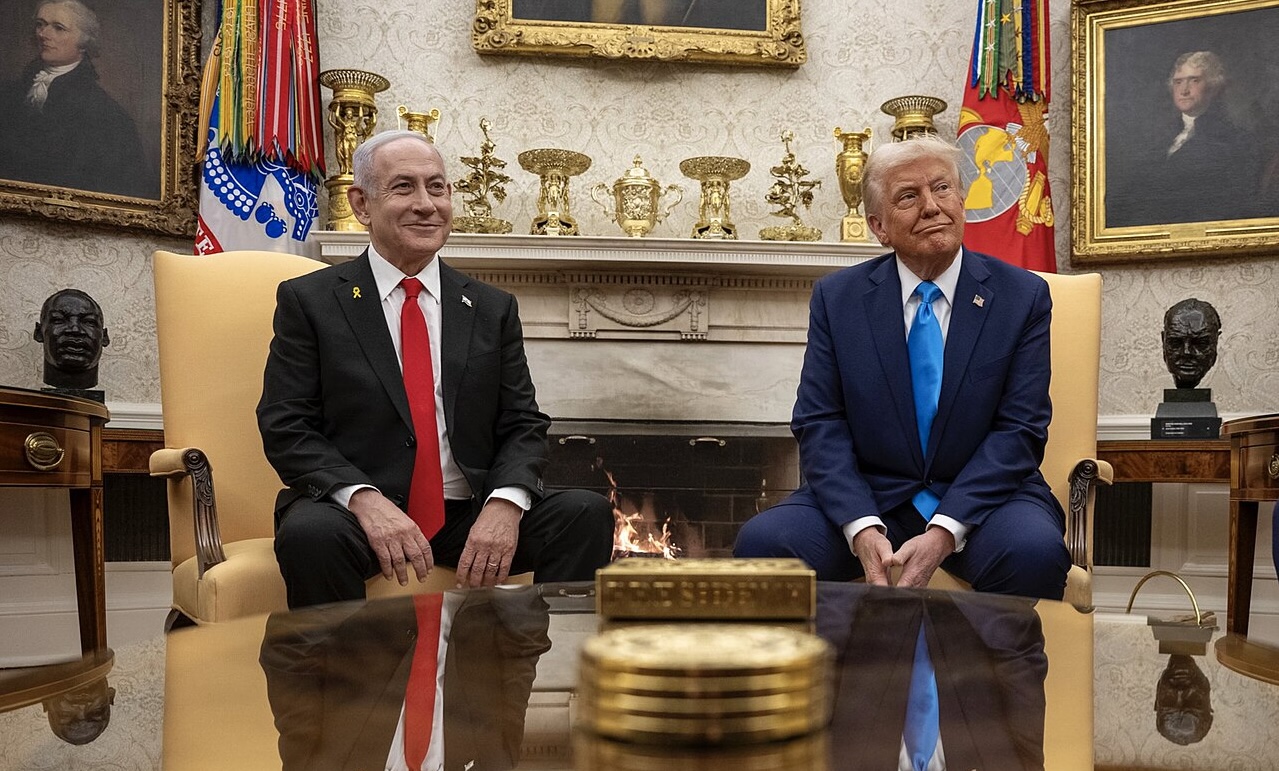
The Netherlands is negotiating with the US over the erosion of the powers of the International Criminal Court (ICC). This erosion is so drastic that, according to legal experts, it would amount to the dismantling of the Court. The Rights Forum has learnt this from diplomatic sources in New York, speaking on condition of anonymity.
The restrictions that would be under discussion include: a) granting immunity to heads of state; b) excluding the Court’s jurisdiction over nationals of non-state parties, even when they commit crimes on the territory of a state party; and c) denying the Court’s jurisdiction over cases covered by national legislation.
First and second restrictions
The first restriction would mean that heads of state and heads of government such as Netanyahu, Trump and Putin could not be prosecuted for crimes committed on their orders.
The second restriction would mean that the ICC could no longer prosecute nationals of non-state parties, even if they commit international crimes on the territory of a state that is a party to the Rome Statute – the founding treaty of the ICC.
Israel, for example, is not a party to the Rome Statute, whereas Palestine is. Consequently, under the current rules, the ICC can prosecute Israeli citizens and government officials for crimes they commit on Palestinian territory. On this basis, the Court has issued arrest warrants for Israeli Prime Minister Benjamin Netanyahu and former Defence Minister Yoav Gallant.
However, if the second restriction were to be adopted, Israeli nationals could no longer be prosecuted for crimes committed on Palestinian territory. The same would apply to US or Russian nationals who commit crimes on the territory of other States Parties.
This would undermine a key principle of the International Criminal Court: that nationals of states which have not ratified the Rome Statute can also be held accountable for international crimes.
Third restriction
The third restriction would mean that the ICC would no longer be permitted to hear cases if a state has legislation enabling it, in principle, to punish offences committed within its own jurisdiction. At present, the Court may still intervene if a state is unwilling or unable to investigate and prosecute suspects (the so-called principle of complementarity). If the third restriction were introduced, the mere existence of national legislation could be sufficient to prevent prosecution by the ICC.
For example: Israel has legislation against torture. It could therefore argue that the ICC has no jurisdiction, even if, in practice, cases of torture are not investigated or prosecuted. In this way, Israel could avert prosecution by the ICC without taking action against the perpetrators itself.
In short: if the aforementioned restrictions are adopted, there will be nothing left of the Court.
In order to enshrine these legal restrictions, the Rome Statute – which established the International Criminal Court in 1998 and under which it has operated since 2002 – would need to be amended. This would require a two-thirds majority of the States Parties. The amendment must then be ratified by seven-eighths of the States Parties before it can enter into force. It is not known which countries would cooperate in this regard.
US sanctions
The reason the Netherlands is said to be negotiating on this matter are the sanctions imposed by the US against thirteen judges and prosecutors, and against the ICC as a whole. This was done primarily in retaliation for the Court’s investigation into Israeli crimes in Palestine, and the resulting arrest warrants for Netanyahu and Gallant. The undermining of the International Criminal Court by the US and Israel has now been going on for almost twelve years.
The Court has been on the US sanctions list since 9 October. However, a number of sanctions will not come into force until 7 April 2027. These would largely paralyse the institution, leaving the European Union with virtually no choice but to activate the far-reaching blocking mechanism. This law obliges European parties to disregard US sanctions and to continue supplying services and goods to the Court and its staff.
The EU, and EU countries like the Netherlands, are, however, reluctant to activate the mechanism due to the consequences it could have for European businesses. For instance, European banks that disregard the US sanctions might find it much more difficult to do business in the US – or could face sanctions themselves.
Opting for a compromise
That is why the Netherlands now appears to be opting for a compromise. By relinquishing certain aspects of the International Criminal Court, the US might be persuaded to lift or ease the sanctions against the Court. In practice, this would amount to amputating the Court’s limbs. What would then remain is a powerless trunk-court.
We are not quite there yet. The States Parties to the Rome Statute will meet in The Hague from 30 November to 7 December. The meeting was originally scheduled to take place in New York, but the US sanctions made it necessary to relocate it.
Response from the ministry of Foreign Affairs
The Rights Forum has asked the Ministry of Foreign Affairs for a response to the reports, but it provides a general, meaningless statement and does not address the specific questions asked:
‘During the previous Meeting of Contracting Parties (in December 2025), it was decided by consensus to encourage contracting parties to enter into further dialogue with non-contracting parties. In the run-up to the upcoming Meeting of Contracting Parties to the Rome Statute (November 30 – December 7), contracting parties will continue to discuss this matter and we will explore the scope available for dialogue with non-contracting parties, within the framework of international law and with respect for the independence and impartiality of the Court.’
‘We cannot yet anticipate how a dialogue will proceed, because that is not up to us alone: the Netherlands, together with the other 124 contracting parties and our European partners have a shared responsibility to the Court to protect. are within the Meeting of Contracting Parties no concrete proposals at the moment. In any case, we will continue to stand firmly in front of the Court and we will continue to make every effort to ensure that the Court functions properly: as a host country and as a treaty party.’
‘Independent courts and tribunals must be able to carry out their mandates unhindered. We also remain fully committed to mitigating the impact of existing sanctions in these capacities, and together with other treaty parties. It is important that the Court can function as freely as possible.’
Lees verder
Lees minder