How Booking.com managed to pocket 4.6 billion euros in Dutch subsidies
Investigation shows that Booking.com has received billions in tax breaks. This despite the fact that the company profits from war crimes in occupied Palestine, and has been sued in the Netherlands for money laundering.
During a parliamentary debate on April 16, Representative Laurens Dassen (Volt) raised a remarkable point. He noted with astonishment that the wealthy company Booking.com enjoyed a 600 million euro tax benefit over 2025. This madness must stop now, Dassen argued. The Rights Forum investigated the matter. The outcome is shocking.
Booking.com and Booking Holdings
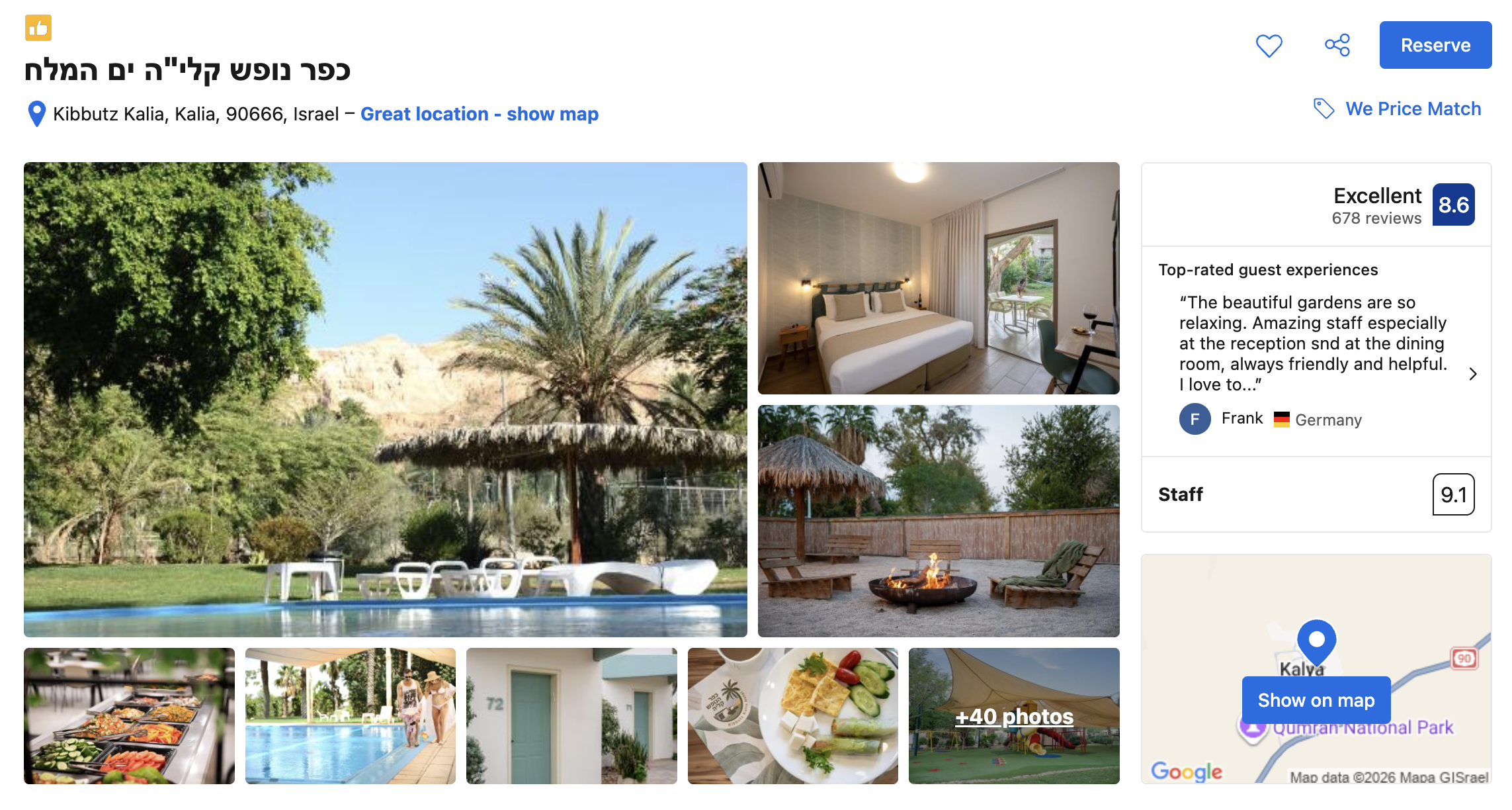
Booking.com is a widely known company. It is, in fact, notorious: on its online platform, it offers accommodations (hotels, apartments, houses) for rent from Israeli settlers in illegal settlements in Israeli-occupied Palestine. According to research by the American organization Ekō, published earlier this month, this involves 41 accommodations spread across 14 illegal Israeli settlements. Booking.com thus profits from activities on stolen Palestinian land and is accused of laundering those proceeds through the Netherlands.
Complaint filed against Booking.com
Booking.com has long been under fire for listing illegal Israeli accommodations on stolen Palestinian land. The Rights Forum is attempting to hold the company legally accountable, but is facing obstruction.
Booking profits from war crimes
Since 1967, Israel has been displacing Palestinian residents of East Jerusalem and the West Bank to colonize their land. Meanwhile, an estimated 750,000 Israeli (and other, including Dutch) settlers live in hundreds of illegal settlements and “outposts” in occupied territory. In April, Israel announced the construction of 34 new settlements.
Under international law, this colonization constitutes a war crime, to which Booking.com contributes and from which it profits. That is why the parent company was blacklisted by the UN in February 2020; in 2026 both Booking Holdings and Booking.com are blacklisted. That designation alone is incompatible with the billions in subsidies that Booking receives in the Netherlands.
Criminal complaint and Article 12 proceedings
In November 2023, The Rights Forum, together with ELSC, SOMO, and Al-Haq, filed a criminal complaint in the Netherlands against Booking for laundering proceeds from war crimes—a criminal offense. Two and a half years later, however, the Public Prosecutor’s Office has yet to take action on the matter.
In April, The Rights Forum and its partners therefore initiated a so-called Article 12 procedure. This asks the court of appeals to determine for itself whether the criminal complaint should lead to prosecution. A crowdfunding campaign has been launched to cover the costs of the procedure.
Ruling by the International Court of Justice
The complaint against Booking received a major boost on July 19, 2024. On that date, the International Court of Justice ruled that Israel’s presence in East Jerusalem and on the West Bank violates the Palestinian right to self-determination and the prohibition on the acquisition of land by force—and is therefore illegal.
The Court instructed the international community—especially states that maintain close ties with Israel—to prohibit economic relations to the extent that they contribute to Israel’s illegal presence in Palestine (see paragraph 278, page 76). Despite this legal obligation, the Netherlands—notably the host country of the Court—has still not implemented the requested ban. Instead, in 2024 and 2025 Booking received tax benefits totaling over 1.2 billion euros.
Expansion of illegal settlements
Following the International Court of Justice’s ruling, the UN ordered Israel to fully withdraw from occupied territory by September 18, 2025, to restore the territory to its pre-occupation status, and to compensate the Palestinian population. Since then, Israel has further intensified its occupation and colonization.
Booking has also ignored the ruling of the International Court of Justice, even though it clearly applies to its activities. Meanwhile, the company—in step with Israel’s rapid colonization—has further expanded its listings of illegal settler accommodations.
In the Netherlands, this “innovative” business model is rewarded with a substantial subsidy.
Lees verderLees minder
The headquarters of the originally Dutch company Booking.com have traditionally been in Amsterdam, but the company has been under American ownership since 2005. It is the flagship of Booking Holdings, which operates under eleven brand names, including—in addition to Booking.com—Agoda, Priceline, Kayak, Cheap Flights, and Rentalcars.com.
Booking Holdings is headquartered in Norwalk, Connecticut, and employs nearly 25,000 people worldwide. The company, listed on the Nasdaq technology exchange, ranks 166th on the Fortune 500—the list of the 500 largest U.S. companies by revenue. The shares are largely held by institutional investors such as Vanguard, BlackRock, and JPMorgan.
Booking’s cash flows
Although Booking Holdings claims to operate in over 220 countries, it has the bulk of its revenue taxed in the Netherlands. “All global revenue flows directly to [Booking.com’s] headquarters in Amsterdam,” Dutch business magazine Quote wrote in April 2019 based on its own research (full version). There is a reason for this: the American holding company receives a substantial discount on its income tax in the Netherlands. It owes this to a favorable program: the so-called “innovation box.”
What is the innovation box?
The “innovation box” is a tax incentive program established in 2010 through which the government aims to stimulate innovation and retain innovative companies in the Netherlands. Companies admitted to the program pay less in taxes on their profits from “innovative activities”: instead of 19 percent (on profits up to 200,000 euros) and 25.8 percent (on higher profits), they pay only 9 percent. In total, approximately 3,000 companies are taking advantage of the program. The government has set aside just under three billion euros for it through 2026.
Recent research by Trouw and Het Financieele Dagblad revealed that just three companies received a whopping 91 percent of the available budget for 2025. Dutch tech giant ASML, Booking Holdings, and the American pharmaceutical company MSD received a combined income tax reduction of 2.7 billion euros. A scandal has erupted surrounding MSD, which has been in the process of withdrawing from the Netherlands for ten years, and the innovation box itself is also under fire.
Lees verderLees minder
Quote’s investigation revealed that from 2010 through 2018, Booking Holdings enjoyed a total tax benefit of 1.8 billion euros, including 385 million euros in 2018. After that, the issue faded from view until Laurens Dassen raised the alarm last month. That prompted The Rights Forum to investigate the years from 2019 onwards.
Billions in Tax Benefits
Our investigation shows that Booking does not channel “all of its revenue” through its Amsterdam office, as Quote reported, but it does channel the majority of it. From 2019 through 2025, Booking Holdings had an average of 78.7 percent of its revenue taxed in the Netherlands. The “innovative portion” of this was taxed under the innovation box, resulting in a tax benefit of no less than 2.812 billion euros.
To illustrate: in 2025, the holding company’s revenue totaled over $26.9 billion (€23.8 billion). Over 80 percent ($21.7 billion) was taxed in the Netherlands, resulting in a tax benefit of $747 million (€661 million).
The holding company’s net profit for 2025 was $5.4 billion (€4.6 billion). Over the seven years we examined, the holding company recorded a cumulative net profit of $24.7 billion (€22.9 billion). The company’s profitability is exceptional.
Booking Holdings Inc.
Tax benefits received in the Netherlands, 2019–2025
wdt_ID
Year
USD
Exchange rate
EUR
Source
1
2019
443
0,893
396
p. 103
2
2020
79
0,876
69
p. 121
3
2021
230
0,845
194
p. 115
4
2022
452
0,949
429
p. 110
5
2023
544
0,925
503
p. 104
6
2024
607
0,924
560
p. 85
7
2025
747
0,885
661
p. 77
Amounts in millions of dollars/euros • Calculated based on the European Central Bank’s (ECB) average annual exchange rate • Source: Annual reports (Form K-10) filed by Booking Holdings with the U.S. Securities and Exchange Commission (SEC), for 2019, 2020, 2021, 2022, 2023, 2024 and 2025.
Added to the 1.8 billion euros revealed by Quote, Booking enjoyed a tax benefit of 4.612 billion euros from 2010 through 2025.
“Legal tax avoidance”
Questions have long been raised about the fact that an extremely profitable American holding company, owned by institutional investors, enjoys enormous tax benefits in the Netherlands. The structure surrounding Booking Holdings bears a strong resemblance to tax avoidance.
Former Member of the Dutch House of Representatives and Member of the European Parliament Paul Tang waged a fierce battle for years against this practice, whereby no tax is paid in the countries where revenue is generated, but rather in the country with the most favorable tax climate.
International outrage and back taxes
These developments sparked outrage in countries where Booking generates revenue on which it pays taxes in the Netherlands—resulting in back taxes and legal charges. In early 2023, Booking reached an out-of-court settlement of 153 million euros in France after being accused of tax avoidance between 2006 and 2018. In late 2023, it settled in Italy for 94 million euros after being accused of evading VAT payments between 2013 and 2019. In Turkey, Booking was hit with a 71 million euro back tax assessment for tax avoidance between 2012 and 2017.
The discontent is global. Quote cites an Australian who calculates that Booking diverts between $100 million and $200 million in revenue from his country annually to have it taxed in the Netherlands. He compares the Netherlands to tax havens like Singapore and the Bahamas. Booking itself insists it complies with the rules everywhere.
Lees verderLees minder
The tax benefit via the innovation box has, in practice, “become a means of legally avoiding taxes,” Tang stated as early as 2018. In March of that year, the European Parliament adopted a motion in which the Netherlands was labeled a tax haven.
Failed “discouragement policy”
Furthermore, the subsidy runs counter to the so-called “discouragement policy.” Through this policy, the Dutch government claims to “discourage” activities in (or for the benefit of) Israel’s illegal settlements in the occupied Palestinian territories. In practice, however, these activities were tolerated or even encouraged, as revealed in 2023 by research from The Rights Forum and SOMO, which we reported on extensively.
Among other things, that research revealed how Booking.com was deliberately shielded from scrutiny behind the scenes. This became clear when then-Prime Minister Mark Rutte visited the company in February 2019. At the time, his cabinet had been informed by the UN of its intention to blacklist Booking due to its activities in (or for the benefit of) Israel’s settlements. But instead of addressing the issue with the company, government officials did everything in their power to avoid it being discussed.
Rutte’s mission was a different one. Blacklist or not, for him, Booking.com was an important employer and “the prime example of a company that should be able to count on somewhat favorable regulations from The Hague,” wrote Quote in 2019. “The Dutch business climate must be geared toward keeping ‘the Booking.coms of the future’ here as well,” the Prime Minister added.
After his visit, the government officials breathed a sigh of relief: the company had not been discouraged. In this way, Booking symbolizes the deliberately failing policy of discouragement. In the twenty years that the policy has been in place, the company has never been discouraged, but has instead been handed over 4.6 billion euros in benefits.
This madness must stop
The conclusion is that an extremely wealthy American company enjoys huge tax benefits in the Netherlands, and that the government is doing everything in its power to ensure this remains the case: turning a blind eye to Booking’s involvement in (and profiting from) war crimes, presumed money laundering and tax evasion; abusing the innovation box and government policy; and undermining the work of the UN and the International Court of Justice.
This madness must indeed stop, as Laurens Dassen argued in the House of Representatives last month. And it must stop right now.