Israeli Climbing Federation Accused of Violating International Law
On 23 July, the International Climbing and Mountaineering Federation will vote on suspending the Israeli Climbing Federation. The Israeli branch establishes climbing routes in the occupied West Bank, where Israel bars Palestinian climbers, and it has close ties to the Israeli occupation army.
It is 7:04 a.m. The alarm on Israeli climber Alex Khazonov’s iPhone goes off. He wakes up looking sleepy, turns off the alarm, and rolls over once more. A beat starts playing, and the video then shows him attempting to climb a rock face, repeatedly falling before finally conquering it. Khazonov is a pioneer of modern competitive climbing in Israel. He has won multiple Israeli bouldering championships and has stood on several World Cup podiums.
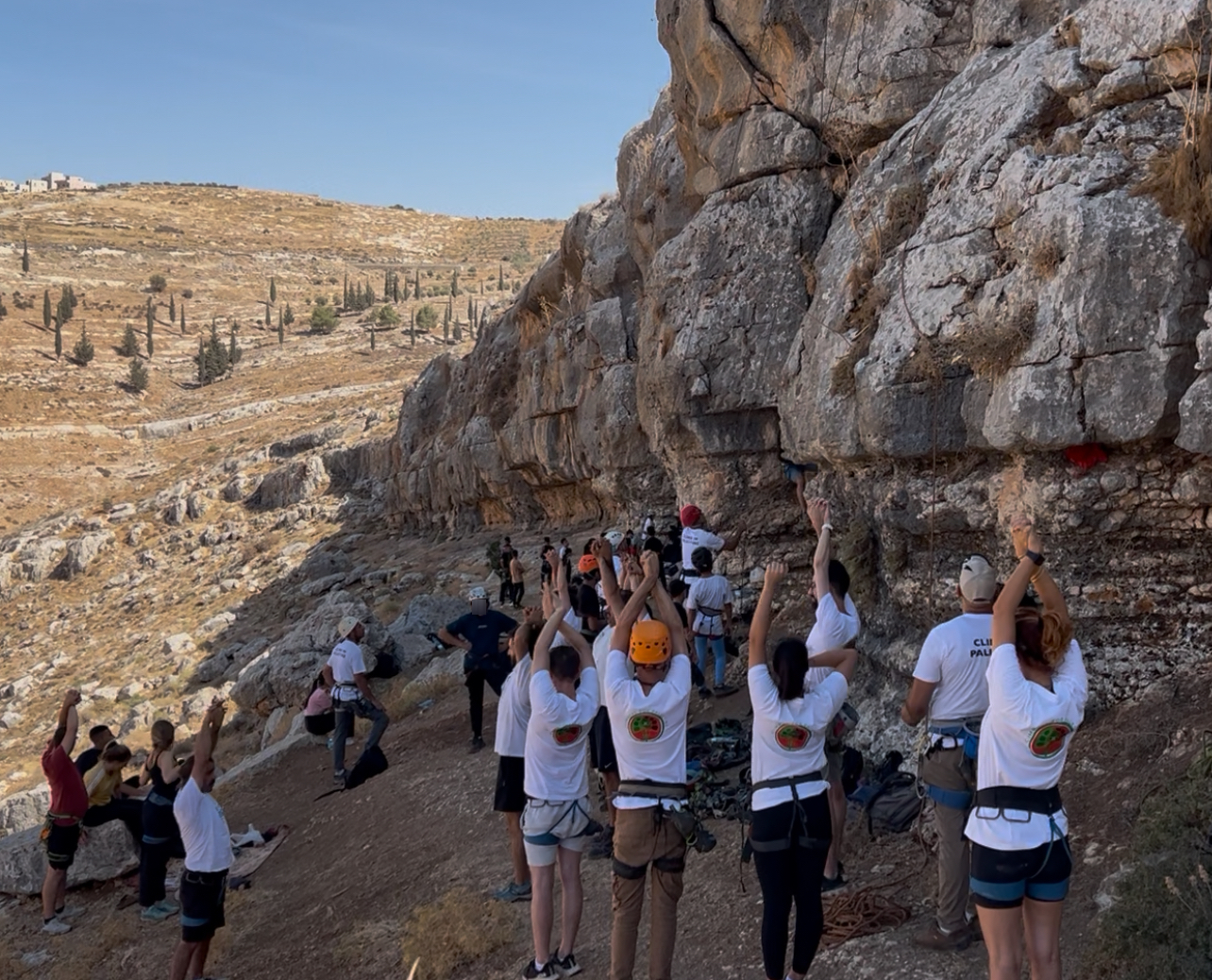
The caption of the video reads: “A day out in Ein Fara, Israel.” On its website, the Israeli Climbing Federation (ICLA) promotes a trip to Ein Fara as “the most beautiful climbing destination in Israel.” But Ein Fara is located in the occupied Palestinian West Bank—not in Israel. Israel has occupied the West Bank for nearly sixty years and has declared many of the Palestinian valleys that Khazonov climbs off-limits to Palestinians.
Momin Abuyacoub lives in Ramallah, about eighteen kilometres west of Ein Fara. “I used to love climbing there with my friends a few years ago,” he says. Between Ramallah and the Ein Fara canyon lies the illegal Israeli settlement of Almon, which Palestinians are not allowed to approach. Abuyacoub and his friends had to make a detour on foot of more than forty-five minutes to reach the canyon and climb there. “Since 7 October, we haven’t been back to Ein Fara,” says Abuyacoub. “We’re afraid of the settlers. They can do whatever they want to us with complete impunity.”
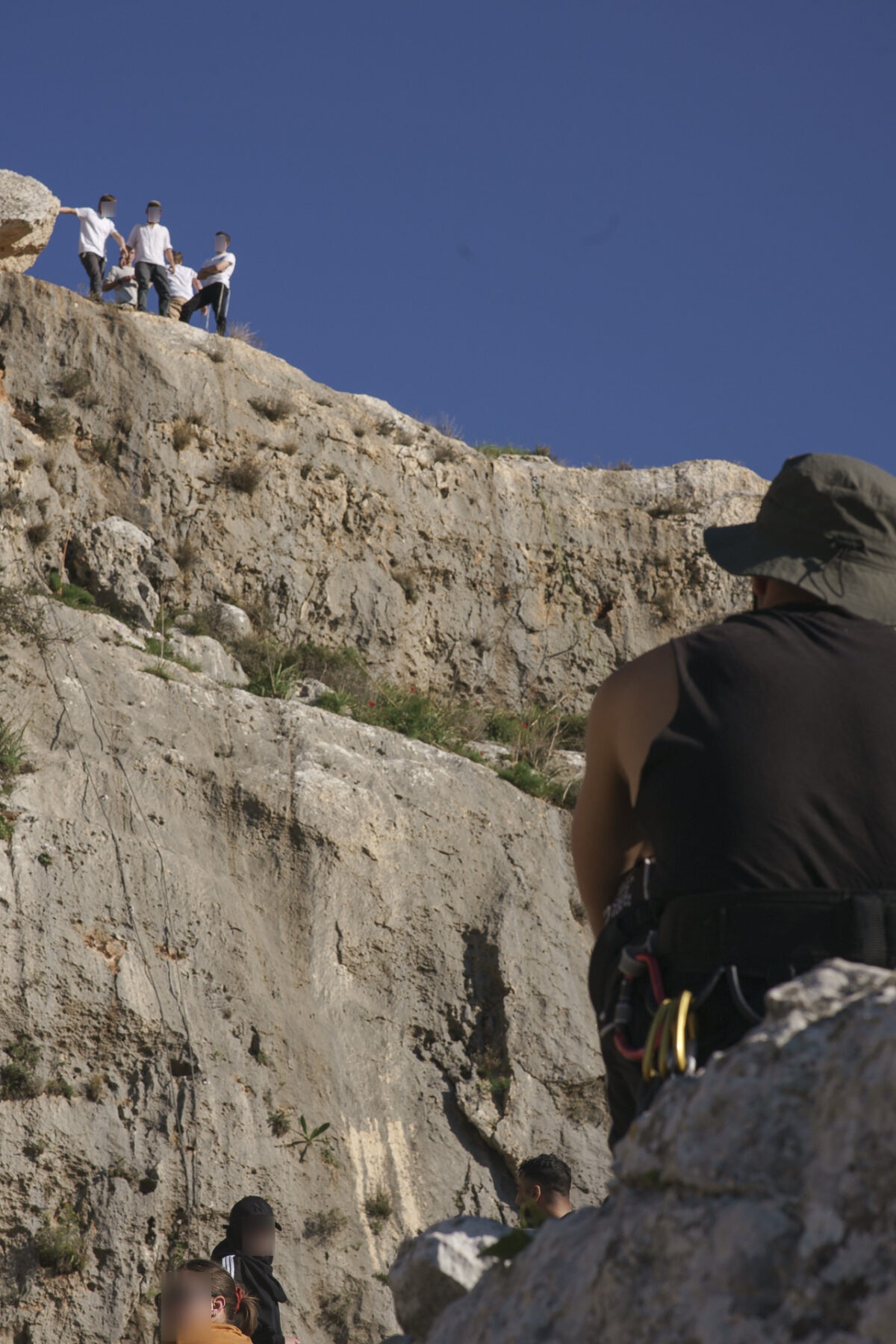
Israeli settlers look at Palestinian climbers from atop a rock wall. [c] Wadi Palestine
Anonymous online vote
Within the International Federation of Sport Climbing (IFSC), calls have been made to suspend the ICLA. By promoting the use of occupied territory by Jewish Israelis and by developing and equipping climbing areas there, the Israeli Climbing Federation is acting in violation of the Geneva Conventions. In 2024, the International Court of Justice declared Israel’s military occupation illegal.
Furthermore, many members of the ICLA’s staff and athletes are active soldiers or reservists in the Israeli military, which is committing genocide in the Gaza Strip. The ICLA also assists in training Jewish Israeli youth for admission into that military.
On 23 July, the IFSC will hold an anonymous online vote on suspending the ICLA. By not acting against the ICLA, the IFSC is complicit in serious violations of international law and war crimes, according to, among others, the Spanish Climbing Federation. Last May, the climbing gym Le Camp de Base in Brussels refused to make its facilities available for the international youth championship Climbing in Europe because Israel was due to participate. “We cannot pretend that the Israeli delegation is neutral,” the organisers of Le Camp de Base said.
Severe restrictions
Back to the Ein Fara canyon, northeast of Jerusalem, on the land of the Palestinian village of Anata. The area is best known for its spring, which has traditionally been the main source of drinking water for Anata and surrounding villages. In 1967, Israel took control of all freshwater resources in the West Bank, including this spring. It built five settlements on the surrounding villages’ land, and in 1980 renamed the area the “En Prat Nature Reserve.” The reserve falls under the Israel Nature and Parks Authority, which manages many of the 48 Israeli “nature reserves” in the occupied West Bank, covering roughly 700 square kilometres in total. Palestinians face severe restrictions in these areas.
Hiba Shaheen, president of the Palestinian Climbing Federation, confirms what Momin Abuyacoub described. “Before 7 October, we went climbing every Friday,” she says. “Afterwards we’d cook a meal together and smoke a hookah. Climbing was our way of escaping the occupation, if only for a while. She sighs. “Now that’s become almost impossible. Israel has sealed off our towns and villages,” Shaheen says. “The Israeli occupation army has erected around a thousand roadblocks for us. And even if we get through the Israeli checkpoints, we risk being shot—by Israeli soldiers or by settlers, who have received large numbers of weapons from their government.”
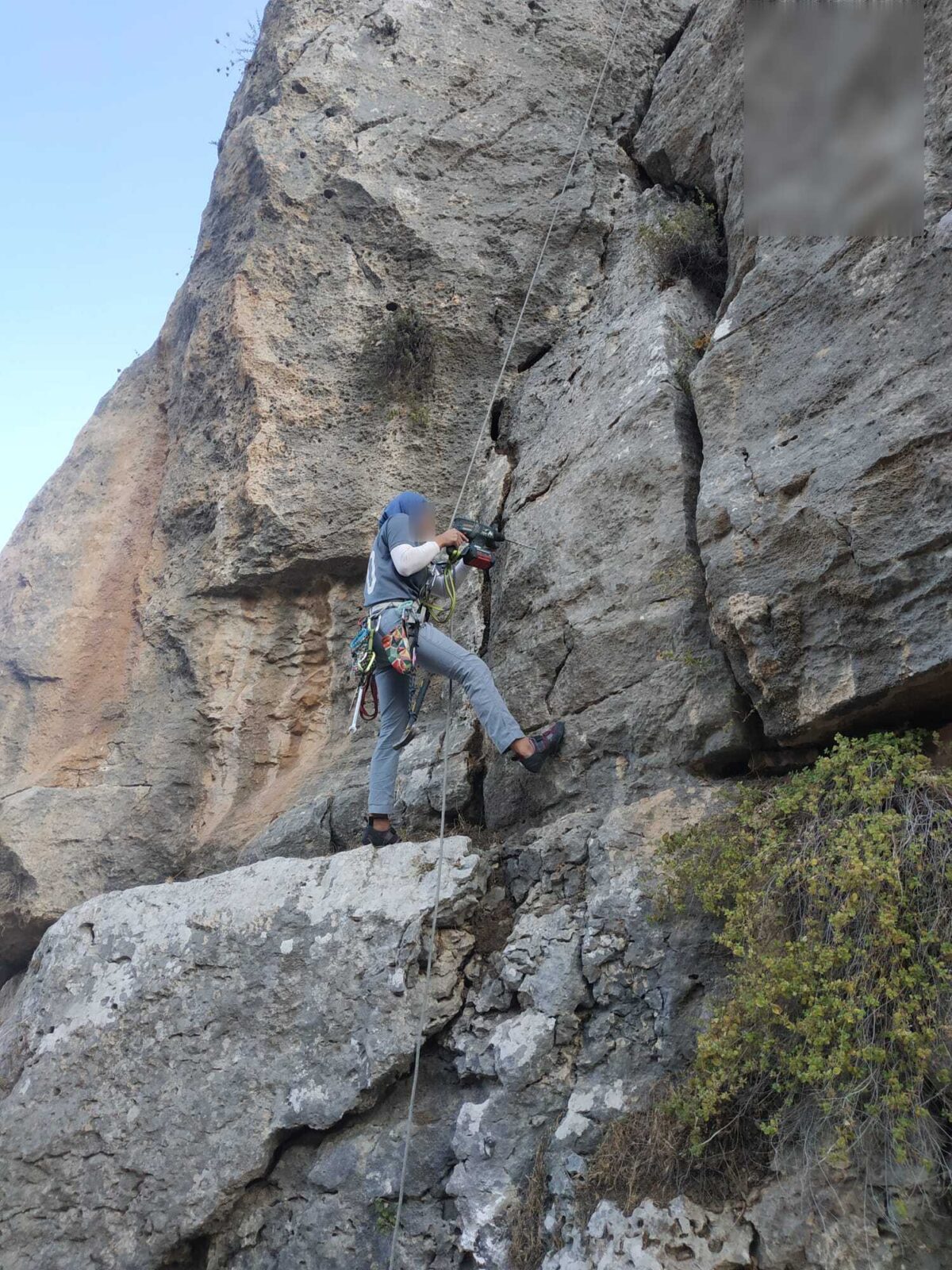
A Palestinian climber builds a new climbing route on the West Bank. [c] Wadi Palestine
Soldiers with M4 rifles
But even before 7 October, Palestinian climbers were already being harassed, according to the article Why Palestinians Can’t Climb Free in the American digital climbing magazine Evening Sends. In 2019, a group of Palestinian and international climbers were sitting around a campfire at the base of the Ein Qiniya canyon, west of Ramallah. Suddenly, settlers shone flashlights down on them from above. Shortly afterwards, the group was surrounded by Israeli soldiers carrying M4 rifles. The Palestinian climbers were ordered to sit on the ground while the soldiers photographed them and their identity cards. They were then escorted away at gunpoint.
The Israel Climbing Guidebook lists numerous climbing destinations in the occupied West Bank in addition to Ein Fara. For this, the authors plagiarised material from the 2019 Climbing Palestine guidebook. One recommended destination is the rock formation at Ein Yabrud, which the Israeli guidebook calls the “Beit El Rock.” It is located beside the illegal settlement of Beit El, founded in 1977 by ultranationalist Zionists. Even before October 2023, Ein Yabrud had been declared a military zone, and Palestinians were barred from entering. That it is a military zone poses no obstacle for Israeli climbers.
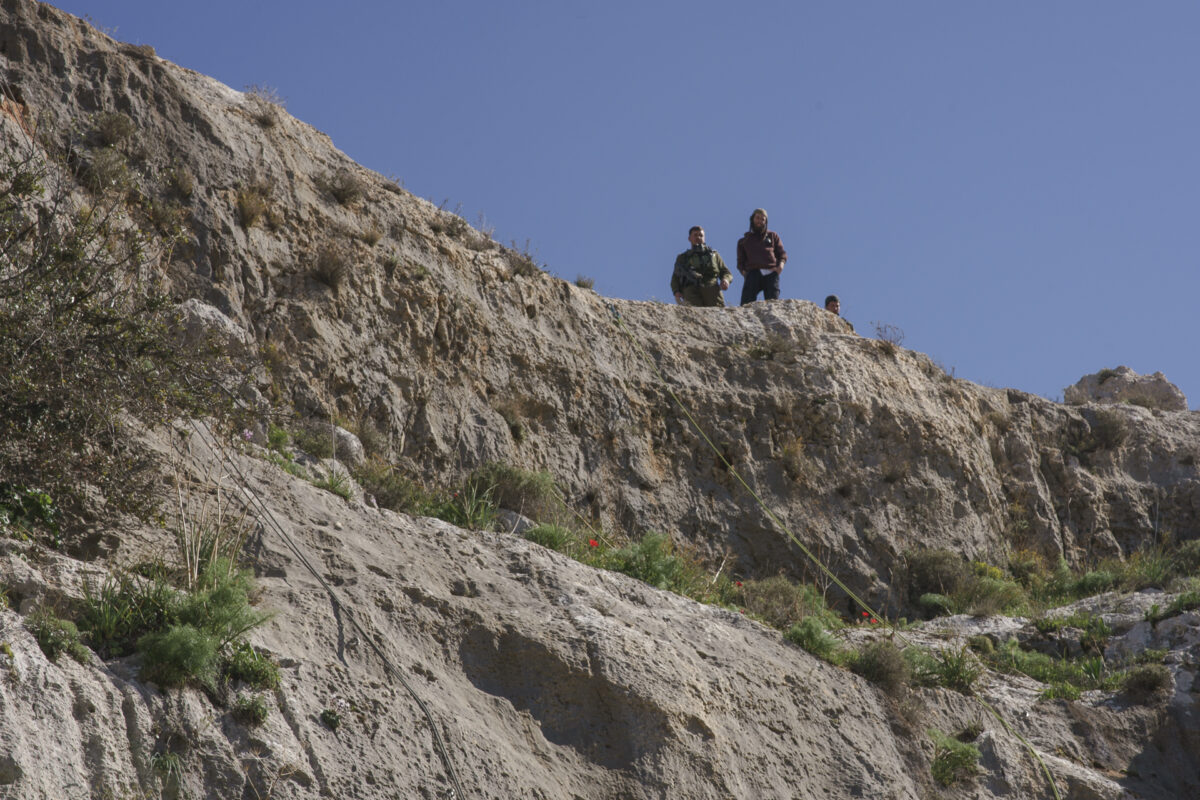
An Israeli soldier and settler look at Palestinian climbers from atop the rock wall. [c] Wadi Palestine
Brand-new illegal neighbourhood
As a result of Israeli restrictions and aggressive settlers, Palestinian climbers in 2026 can now practice their sport almost only exclusively indoors. One such facility is the climbing gym of the Wadi Palestine climbing club in Ramallah. However, the nearby illegal settlement of Kochav Ya’akov has expanded significantly toward Ramallah in recent years, adding hundreds of housing units in the brand-new ultra-Orthodox neighbourhood of Tel Zion. As a result, the settlement is now only about 300 metres from the climbing hall.
Another climbing gym opened in central Ramallah near Duwar as-Saa’a (Clock Roundabout). But because Israel revoked tens of thousands of Palestinian work permits after 7 October, among other factors, many Palestinians have lost their income. The new climbing gym has since closed. They can still climb on the West Bank, but in places that are further away from Ramallah.
Meanwhile, increasing numbers of Jewish Israelis visit the West Bank on Shabbat, Israel’s weekly day of rest. They come to hike, climb, and swim in the crystal-clear waters of springs that Israel has made inaccessible to Palestinians. Jewish Israeli climbers have effectively taken over the cliff at Ein Fara. A YouTube video from 2013 shows a group of at least fifteen Israelis climbing in the canyon. Today, not a single Palestinian can be seen there anymore.
For decades, Israel has treated the occupied Palestinian West Bank as its own backyard. Since 1967, when the occupation began, Israeli classrooms have displayed maps on which the border between Israel and the West Bank is absent. Under the 1993 Oslo Accords, Israel was granted full control over more than sixty percent of this occupied Palestinian territory. That arrangement was intended to be temporary, but today more than half a million Israeli settlers live in that sixty percent, including members of parliament and justices of Israel’s Supreme Court. In East Jerusalem, which is also occupied by Israel, more than 250,000 settlers have established themselves.
Israel has also continued to take over increasing amounts of land in the remaining forty percent of the West Bank. “Judea and Samaria are the heart of Israel,” say the rapidly growing number of religious Zionist settlers, who refer to the West Bank by the names of the two biblical Israelite kingdoms they believe once existed there. In their view, Palestinians should leave their own Palestinian homeland. “God promised this land to us, the Jewish people.”